Reach for the Stars: Computational Models for Teaching and Learning in Physics, Astronomy and Computer Science is a GK-12 program funded by the National Science Foundation, with support from CIERA and Northwestern University.
This NSF program places STEM graduate student fellows in K-12 science classrooms for the academic year with the goal of enriching their education and strengthening their development as researchers by advancing their communication and teaching skills. The fellows work in partnership with a collaborating teacher to bring more inquiry-based teaching methods into the classroom and to further expose K-12 teachers and students to the research process. Through Reach for the Stars, GK-12 fellows will adapt concepts of computational thinking and actual computational modeling tools from their research work to classroom activities connected to the existing math and science curriculum.
Over the years, our fellows have put together lesson plans, on a wide variety of topics, that are free to download for use in your classroom.
Remote Learning
Looking for remote lessons for your students? Check out these options, more coming soon!
Programming with Python
IDEASpy is a beginner Python course tailored to those interested in scientific computing and data science. The course is presented in the form of Jupyter notebooks and assumes no prior knowledge of Python. Each module introduces a new larger topic in Python, as well as at least one challenge set at the completion of module sections. Visit the CIERA GitHub page to begin.
Astronomy:
Wrestling of Stars at Close Encounters
Introduce students to N-body simulations and Python in this fully remote lesson. Students can view the N-body Simulator PowerPoint deck and follow the directions in the N-body Simulation Tutorial.
Teachers can obtain the full lesson plan for NGSS standards addressed, background, teaching notes, and more at this link.
Why Does an Astronomer go to Antarctica?
Paul Williams, a PhD student in Astrophysics at Northwestern, had a BLAST in Antarctica. Why did an astronomer travel to Antarctica for research? Watch this video and find out!
Life Science:
Simulating Human Population Dynamics
Students can access the Human Population Dynamics model on the web-based version of NetLogo found here. Download the Simulating Human Population Dynamics handout and follow the instructions.
Teachers can obtain the full lesson plan for NGSS standards addressed, exit slips, assessment materials, background information and teaching notes at this link.
Testimonials

“GK-12 is invaluable to me, post-graduation. I often find myself remembering lessons from the program. Much of my job now is communication and education with my users: scientists from diverse backgrounds. We also work often with outside donors – as we’re a non-profit research institute – so the lessons I learned from GK-12 are critical to building knowledge.”
Dorothy Wheatcraft
Mass Spectrometry Scientist and Manager, Jackson Laboratory in Bar Harbor, ME
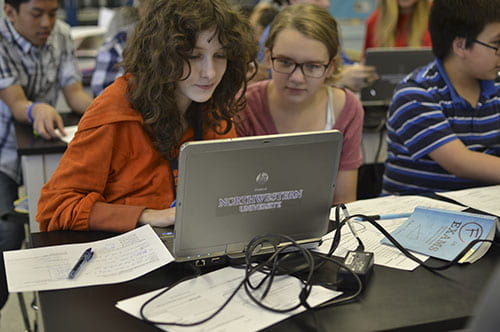
“RftS has opened up a whole new world in my physics classes. Before participating in this program, I did not know what computational modeling was, and I did not know how to do any computer coding. Through lesson planning with my graduate fellow, I have learned how to code a little bit, and how to apply that code to introduce computational thinking. Without RftS, I would not have the dynamic and important lessons my students have now had the opportunity to learn.”
Katie Page
Physics Teacher, Prospect High School in Mount Prospect, Illinois